Mera Peak Climbing
Trip Facts
 Duration
14 Days
Duration
14 Days
 Trip Grade
Moderate
Trip Grade
Moderate
 Country
Nepal
Country
Nepal
 Maximum Altitude
6,461 m
Maximum Altitude
6,461 m
 Group Size
1-16 People
Group Size
1-16 People
 Starts
Kathmandu
Starts
Kathmandu
 Ends
Kathmandu
Ends
Kathmandu
 Activities
Trekkin & Climbing
Activities
Trekkin & Climbing
 Best Time
March.April.May | Sep. Oct.Nov
Best Time
March.April.May | Sep. Oct.Nov
Overview
Mera Peak climbing (6,461m/21,192ft) is an incredible option for a first time high-altitude climber wanting an adventure on a trekking peak. Mera Peak is situated in the secluded, pristine Hinku Valley of the Everest region of Nepal and has some of the most beautiful hiking landscapes in addition to having one of the best summit views in the entire range. Mera Peak’s summit offers breathtaking vistas of five of the world’s highest mountains, Lhotse (8,516m), Makalu (8,485m), Cho Oyu (8,188m), Kanchenjunga (8,586m), and Everest (8,848.86m), in addition to the endless expanse of the snow covered peaks of eastern Nepal.
This 14 day Mera Peak climbing itinerary allows for ample time to adjust to the low oxygen levels while maintaining the highest degree of safety and success. To start the adventure, first the climbers must arrive in Kathmandu, then fly to Lukla to access the Everest region. The main Everest Base Camp trail is not as desirable as the Hinku Valley trail, which is followed through Chhutang. Then, the Zatrawala Pass is crossed before descending to Tuli Kharka and Kothe. On this trail, the picturesque forests, meadows, and rivers of the untouched Himalayas, in addition to the traditional Sherpa towns and the Rhododendrons and Pines, are all passed.
The journey to Thangnak and Khare brings you deeper into the rugged Alps, the terrain more challenging, and the mountains around you taller and dusted with snow. You will spend a day in Khare acclimatizing with your climbing guide to prepare for the climb. You will get a review of the basic mountaineering skills needed to summit, like the use of crampons and ice axes, as well as safety harnesses, helmets, and fixed ropes.
Mera High Camp brings you one climb closer to the peak, with magnificent views of the easier Himalayan climbs that lie before you. The initial leg of the summit pushes you out onto the glacier before sunrise, with a starry sky overhead. Mera Peak is labelled a ‘non-technical trekking peak’ because the main challenge is the high altitude, which is less of a concern with proper acclimatization. You will also need a good level of fitness as the climb can test your determination. The experience of standing at the top is the peak of the climb and offers an unparalleled panoramic view.
Once the Mera Peak climb is complete, you have a lot of ground to make up. The descent from Khare, Kothe, and Tuli Kharka is the same as on the climb out. You will again cross the Zatrawala Pass to get back to Lukla. You take a scenic flight back to Kathmandu before you depart for your next destination, leaving behind the memories of a lifetime from the Himalayas.
For experienced trekkers making their first ascent of the Himalayas, and for those wanting a challenging yet manageable trek, Mera Peak is a delightful choice. It’s fantastic trekking, fantastic climbing, fantastic views and Sherpa hospitality. The acclimatization process, experience of the guides and the itinerary have a decent chance of taking you to one of the highest trekking peaks in Nepal and a decent immersion into the spirit of the Himalayas.
Highlights
- Mera Peak (6,461m) Highest trekking peak in Nepal.
- Unbelievable views of Everest, Lhotse, Makalu, Cho Oyu and Kanchenjunga.
- Enjoy scenic Flights from Kathmandu to Lukla.
- Hike through the beautiful and unspoiled Hinku Valley.
- Enjoy the amazing Zatrwa Pass.
- Rope in Khare for acclimatization and pre-climb training.
- Sleep at Mera High Camp before the big push.
- For the novice climber, the Himalayas are a great starting point.
- Experience Sherpa guides and travel on the glacier.
- Enter the ancient world of traditional Sherpa culture in mountain villages.
Mera Peak Climbing Itinerary
Day 1: Arrive in Kathmandu

 Transportation: Car or bus
 Travel Duration: 30 min
 Accommodation: 3 star hotel
 Activities: Trekking
 Maximum Altitude: 1350m
Welcome to Nepal! After you arrive at Tribhuvan International Airport (KTM) and go through customs, an airport representative will greet you and take you to your hotel. You may wish to take the time to rest after your long journey, or you may wish to explore the streets of Thamel, a popular district among tourists. You will meet your climbing guide who will go over the itinerary for the trip, check your gear, and do last minute trip preparations. You will spend the night in a hotel in Kathmandu.
Day 2: Fly to Lukla and Trek to Chhutang
Transportation: Car
Travel Duration: 30 min
Accommodation: Hotel
Activities: Trekking
Maximum Altitude: 1200m
 Highlights: Nature
Your day will begin with an early morning flight to Lukla. This flight gives amazing views of the Himalayas from your aeroplane window. Once you arrive at Tenzing-Hillary Airport, your true trek will begin. Instead of taking the well travelled route to Everest Base Camp, you will take the much more peaceful route through the Hinku Valley that offers a blend of rhododendron and pine trees. As you continue your trek, the peaceful mountain village of Chhutang, surrounded by numerous forests, will come into view. This trek is shorter than usual to help your body begin to acclimate to the elevation.
Day 3: Trek from Chhutang to Tuli Kharka
Transportation: car
Travel Duration: 45m
Accommodation: 4 star hotel
Activities: Travelling
Maximum Altitude: 1350m
Highlights: travelling
Today's trek winds its way through the forests, ascending to the Zatrawala Pass (4,610m). The view from the pass is incredible, revealing Numbur Himal, Kongde Peak, and many other mountains that, like Kongde, are capped with snow. The trail continues to Tuli Kharka, which is an alpine meadow.
Day 4: Trek from Tuli Kharka to Kothe
Transportation: Bus
Travel Duration: 35-50 mins
Accommodation: 3 star hotel
Activities: Travelling
Maximum Altitude: 1350m
This section of the trail flows through the lower elevation forests of rhododendron and juniper. The trail leaves the alpine meadows and descends into the remote Hinku Valley. The glacial rivers are crossed by bridges that span their swift flow, and offer stunning views of Mera Peak and the surrounding mountains. Kothe is a welcome site after the day's trek, where the Hinku and Kothe rivers intersect. Kothe is lightly populated, but a key location for climbers and trekkers headed to Mera Peak.
Day 5: Trek from Kothe to Thangnak
Transportation: Bus
Travel Duration: 40 min
Accommodation: 4 star hotel
Activities: Travelling
Maximum Altitude: 1450m
Highlights: Travelling
The hike along the Hinku River offers picturesque views of the wide river valley that is flanked by steep cliff walls, alpine in nature, and filled with glaciers. You will notice the impacts of the changing climate on the land with growing rocky roughness that breaks away the ancients soft flow. Along the way, views of Kusum Kanguru, Mera Peak, and many glacier-scarred peaks will stay with you. Gradual elevation gain will bring you to Thangnak, a temporary village settlement on the hillside. Here, you will realize that you are now in the high mountains of the cool alpine.
Day 6: Trek from Thangnak to Khare
Though the trek today covers a short distance, the hike will feel longer with elevation gain working against you. You will hike next to the Dig Glacier. Here, you will be afforded a view of glacial moraines, icy streams, and snow-blanketed peaks. Mera Peak will capture your attention and add to your growing excitement for the days to come at the village settlement of Khare. A break after the short trek will be rewarded with amazing Himalayan views.
Day 7: Acclimatization Day at Khare
Before you continue your ascend to high altitudes, this important rest day will allow your body to acclimatize. To facilitate this, a short acclimatization hike will be undertaken to the nearby ridges. Alternatively, a portion of the day will be set aside to allow you to practice using climbing equipment (e.g. crampons, harness, ice axe, helmet, ascenders, and rope) with your climbing guide. When the time to summit arrives, this practice will ensure that you are summiting with confidence and equipped for the task at hand.
Day 8: Trek to Mera High Camp
You will start the day by trekking up to the Mera Glacier, where you will be trying your climbing gear for the first time. Making your way across the glacier will start your introduction to alpine climbing as you make your way to Mera High Camp. Located along a rocky ridge, High Camp provides a stunning view of the Himalayas, as well as views of Everest, Makalu, Cho Oyu, Lhotse, Nuptse, and many other peaks. We will make an early dinner and go to bed early to make our summit attempt before the sun rises.
Day 9: Summit Mera Peak (6,461m / 21,192ft) and Descend to Khare
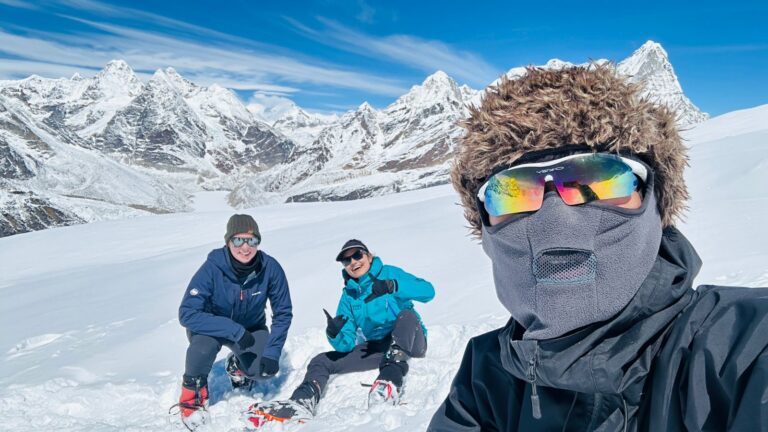
The highlight of your trip will happen today! You and your team will leave before the sun rises to make your way to the glacier with the guide, while the sky is filled with stars. You will be rewarded with amazing views of the Himalayas, as well as the views of the gradual snow slope, when you reach the summit. From the top of Mera Peak, you will have one of the best views in all of Nepal, including the five tallest peaks of the world: Everest, Lhotse, Makalu, Cho Oyu, and Kanchenjunga. From the summit, you will begin your summit celebration and take many photos before hiking back to High Camp, and then to Khare for some well deserved rest.
Day 10: Trek from Khare to Kothe
Following breakfast, take the same path back along the Hinku Valley. It will be easier to navigate through Thangnak because of the altitude change, as your breathing will be less laboured. The picturesque view of alpine shrubbery and rocky glacial rivers will accompany you as you make your way to Kothe, which is more relaxing with its comfortable lower altitude after your summit.
Day 11: Trek from Kothe to Tuli Kharka
The hike from Kothe begins with an ascent through more beautiful forests accompanied by the serene landscape of the mountains. You'll walk past waterfalls and a rhododendron forest before reaching the alpine pastures of Tuli Kharka. The elevation gains and there are beautiful views of the Himalayas that you won't want to miss on the way, especially after the successful climb.
Day 12: Trek from Tuli Kharka to Lukla via the Zatrawala Pass
Your last day of trekking entails climbing back up the Zatrawala Pass, which will reward you with your last view of the Hinku Valley, a snow capped mountain range, and all of the remoteness the area has to offer. The Pass will mark the beginning of a descent that will take you through Sherpa villages and forests before arriving in Lukla. Your team will celebrate the successful completion of the Mera Peak expedition in the evening.
Day 13: Fly From Lukla To Kathmandu
After breakfast, board an early morning flight to Kathmandu from Lukla. The 35 minutes short flight showcases the mountains and is one last chance to view the stunning peaks and finally say goodbye to everest region peaks. After checking in to your hotel in Kathmandu, the rest of the day is yours for exploration or rest. There is an optional farewell dinner that night to celebrate the completion of the Mera Peak Climbing adventure.
Day 14: International Departure

Once the farewell dinner is complete, the Mera Peak Climbing adventure is officially over. Depending on your flight schedule, there may be time for one last exploration or shopping in Kathmandu before being taken to Tribhuvan International Airport. Remember your time in the Hinku Valley, on the peaks, and with the hospitality of the Sherpa on your journey home, and come back for more trekking in the Himalayas.
Includes/Excludes
What's Included?
- KTM International Airport arrival and departure transfer by private car/van/Hiace
- 3 nights deluxe hotel accommodation in Kathmandu on B/B twin-sharing basis (3-star equivalent)
- Round-trip flight Kathmanduu2013Luklau2013Kathmandu for guests and guide with all taxes included
- Private transportation between hotel and domestic airport by car/van/Hiace
- Porter service (1 porter for every 2 persons to carry luggage and climbing equipment)
- Experienced English-speaking government-licensed Sherpa climbing guide for the entire trek
- Full board meals (breakfast, lunch, and dinner) as per itinerary during trek and climb
- Tea house accommodation during trekking and tented camping accommodation during climbing (twin sharing)
- Mera Peak climbing permit included
- Essential trekking equipment provided including down jacket, sleeping bag, walking stick, water bottle, plus welcome dinner, farewell dinner, and summit trip certificate
What's Excluded?
- International airfare to and from Nepal
- Nepal visa fee and required passport size photos
- Travel and health insurance including emergency helicopter rescue insurance (highly recommended)
- Lunch and dinner in Kathmandu (approx. USD 5u20138 per meal in tourist restaurants)
- All alcoholic drinks, cold drinks, bottled/boiled water, beverages, and desserts during trek
- Tips for guide and porter (expected but not mandatory)
- Hot showers and battery charging services during trek (extra cost or sometimes free in some lodges)
- Costs due to unforeseen situations such as flight delays, cancellations, illness, or emergency rescue
- Extra expenses caused by bad weather or other uncontrollable circumstances
- Any services or items not clearly mentioned in the u201cCost Includesu201d section
- Personal hot or cold drinks and additional beverages during the trek
- Full set climbing gear rental (rope, boots, ice axe, harness, crampons, jumar, etc.) available for hire from Thangnak
Essential Information
Best season
The best times to attempt Mera Peak Climbing are during Spring (March - May) and Autumn (September - November). Spring is characterized by moderate temperatures and low precipitation. The Rhododendron forests bloom and there is great visibility of the mountains. Autumn is similar, but features clear skies, dry trails, and brisk air. Winter (December - February) is only for the experienced, but it is characterized by heavy, cold snowfall. The monsoon season (June - August) is a no-go. The trails are muddy, there is heavy precipitation, and the visibility is poor.
Difficulty Level
Mera Peak Climbing is of moderate difficulty. It is the tallest trekking peak in Nepal, but it is not very technical and is often suggested as the first Himalayan climb. The greatest difficulty is the altitude. The trek features sustained walking for many days, travel over glaciers, and the use of basic mountaineering gear; crampons, harnesses, and ice picks are the basic gear. Good condition and proper acclimation are the keys to the success of this peak.
Elevation and Distance
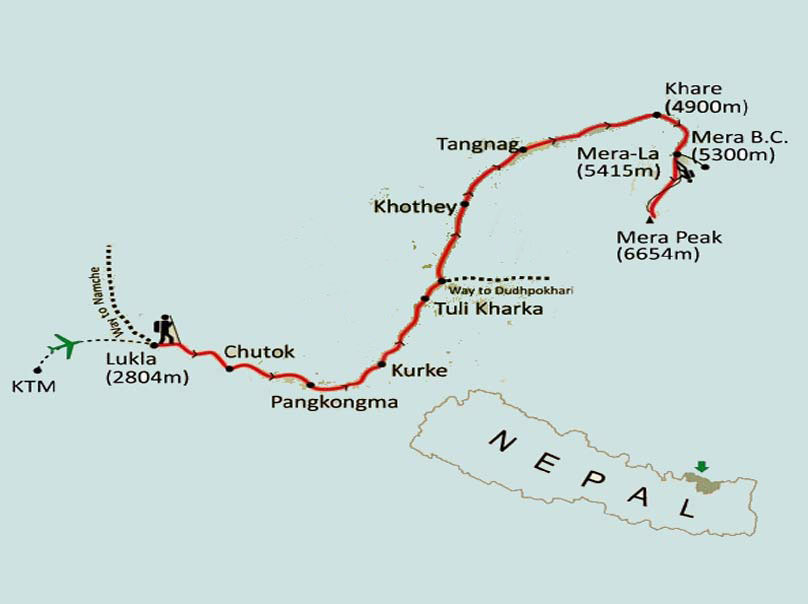
This peak attained a height of 6,461 meters. Kathmandu is at a height of 1,345 meters. The climb progresses through Lukla, Chhutang, Tuli Kharka, Kothe, Thangnak, Khare, Mera High Camp, and the summit. The total trek is 90 to 100 kilometers (56 to 62 miles).
Altitude Sickness
One of the biggest issues with the Mera Peak Climb, which reaches over 5,000 meters, is altitude sickness. Problems like headaches, nausea, dizziness, fatigue, and loss of appetite can all occur from a quick ascent. To help with this problem, the schedule has one acclimatization day in Khare. The risk to your health is greatly decreased by drinking lots of water, walking at a normal pace, eating lots of good food, and listening to your guide. All experienced guides place the highest importance on the safety of the climbers. This is the reason they do things like monitor the climbers.
Minimum and Maximum Hours of Walking
The amount of walking done on almost all days of the trek is between 3 and 7 hours. The shortest day of walking is in the trek from Thangnak to Khare. This trek is done in 3 hours. The longest day of walking for the trek is the summit trek. This trek is done between 8 to 9 hours. This trek is done from Mera High Camp to Mera Peak and back to Khare. The best way to increase the effectiveness of acclimatization is to take lots of breaks and walk at a slow pace.
Accommodation
There are two different types of accommodations that are available over this trek: Tea Houses and Mountain Lodges. Tea Houses and Mountain Lodges both have rooms that are shared by 2 people and have basic amenities. Due to the remote alpine nature of the environment at Mera High Camp, climbers stay in tents. In Kathmandu, all climbers stay at a comfortable hotel for both the beginning and end of the expeditions. The conditions become more basic as the elevation gets higher. The local Sherpas’ hospitality makes these accommodations a pleasant experience.
Food & Drinks
Teahouses provide trekker meals that are nutritious and provide sustenance for demanding trekking at high altitudes. Popular teahouse meals include dal bhat, fried rice, noodles, pasta, and a variety of soups. Eggs, pancakes, bread, porridge, and potatoes are other good meals. These are combined with hot drinks. Water kept at a good boiling point and teahouse drinks are suggested for good hydration.
Can Beginners Join This Trip?
Yes. Mera Peak is considered one of the good beginner peaks for trekkers who are physically fit and willing to challenge themselves. It is better to have high altitude trekking experience, but it is not considered essential. A small briefing on ice climbing and glacier travel will be provided by your climbing guide before this is attempted. Thorough planning and preparation, combined with the guide and the most important aspect of all, your own willpower, will help most first time climbers reach the summit.
Permits
There are varying permits for Mera Peak Climbing. These include the Mera Peak Climbing Permit, the Makalu Barun National Park Entry Permit, and the Khumbu Pasang Lhamu Rural Municipality Permit. Typically, your trekking company will take care of these permits before the start of the trek.
Preparation and Fitness
An important component in having a successful Mera Peak expedition is the training you do at least 3 months in advance. It is vital to train your leg and core muscles as well incorporate cardio in the forms of swimming, hiking, biking, and running. To acclimatize your joints and muscles to being under the strain of having a heavy backpack, do inclined training. Mental preparation and the correct equipment are also important for high altitude treks.
Gadgets Charging & Internet
Most teahouses have electricity, but charging your electronics may come at a cost. This is most likely going to be the case the higher in altitude you go. For this trek, it is highly suggested to bring spares of your batteries and to have a good supply of power banks. Cell phones have coverage in the lower villages, but the coverage declines quickly as you gain altitude. There are lodges that have Wi-Fi, but it may come at a cost. In general, the internet in the remote areas of these mountains is very slow and unreliable.
Conclusion
The Mera Peak Trek offers an exhilarating and unforgettable experience that encompasses rich culture, awe-inspiring views, and the fulfilment of summiting what is considered the highest trekking peak in Nepal. The trek utilises extensive methodology for planning the most effective approach for acclimatization. It includes professional Sherpa climbing guides to ensure a high success rate and helps make your first ever summit a high altitude, large scale trek.
Route Map
Faqs
Is prior climbing experience required for Mera Peak?
Since trekking peaks are intended for novice climbers, prior climbing experience is not required for Mera Peak. However, participants should be in good shape, ideally have some experience with trekking at high altitudes, and be prepared for a short hike to practice using trekking tools. Additionally, you will be given a short lesson by your Sherpa climbing guide training you how to use crampons, an ice axe and harness, and other climbing tools.
What is the level of difficulty for climbing Mera Peak?
The climbing route for Mera Peak is moderately difficult. Because Mera Peak is at a high altitude of 6, 461 meters (21, 192 feet) climbing this trekking peak is physically demanding. Mera Peak climbing is not a technical climb, but is strenuous.
What is the optimal time of year to climb Mera Peak?
The best times of year to climb Mera Peak are in the spring (March to May) and autumn (September to November) because these times of year have stable weather conditions, improved climate, and the highest chances of a successful peak summit.
What are the climbing permits required for Mera Peak?
To climb Mera Peak, you must have three permits. These are the Mera Peak Climbing Permit, the Makalu Barun National Park Entry Permit, and the Khumbu Pasang Lhamu Rural Municipality Permit. Most trekking companies handle the permitting process on your behalf.
What is the percentage of successful summits for Mera Peak?
Mera Peak is a relatively easy trekking peak with a high successful summit rate when climbers follow a well-planned itinerary, are properly acclimatized, and are distanced from others, guided by experienced Sherpa climbers with lengthy climbing experience. Following the instructions of your guide and proper nourishment and hydration will greatly increase your chances of a safe and successful summit.Is prior climbing experience required for Mera Peak?
n
Since trekking peaks are intended for novice climbers, prior climbing experience is not required for Mera Peak. However, participants should be in good shape, ideally have some experience with trekking at high-altitudes, and be prepared for a short hike to practice using trekking tools. Additionally, you will be given a short lesson by your Sherpa climbing guide training you how to use crampons, an ice axe and harness, and other climbing tools.